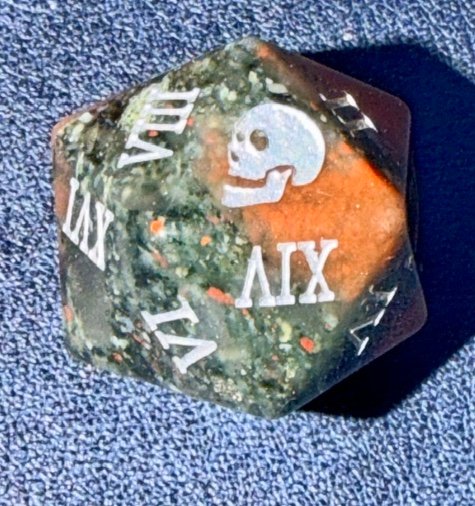
Who hasn’t bought a stone d20 with roman numerals on impulse? Answer: most people.
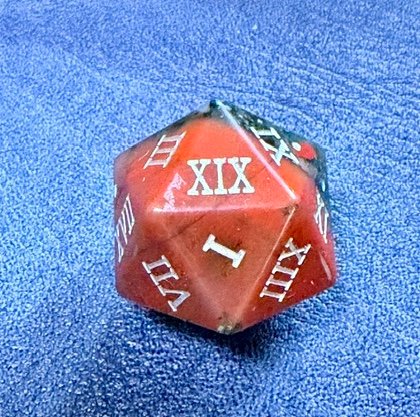
Name: Bloodstone Gemstone Roman Numeral Skull DnD D&D Dice
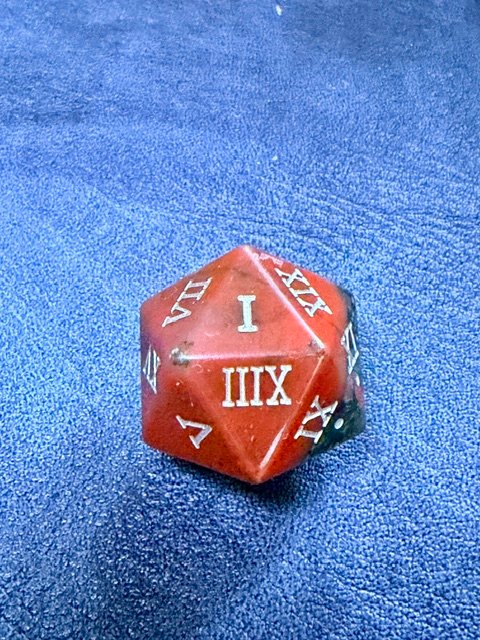
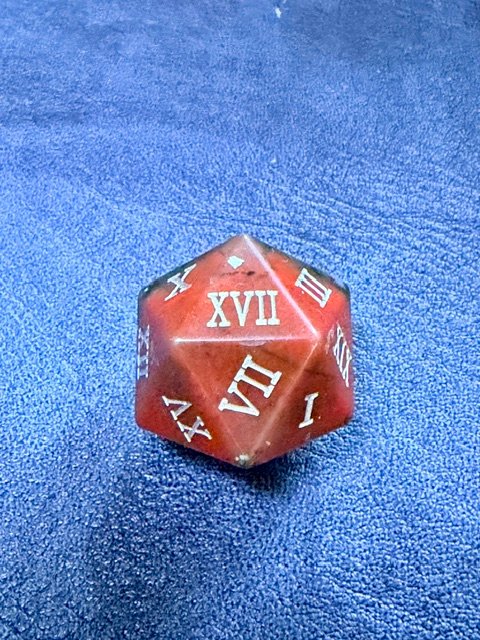
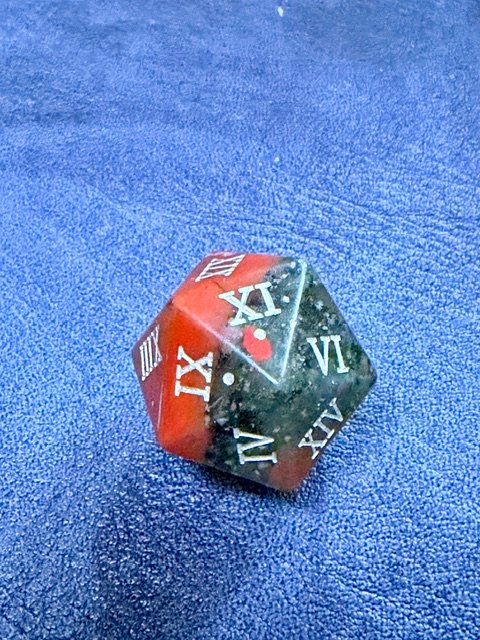
Description: This is a single stone d20 made of “Bloodstone” also known as “Heliotrope“, is a dark green mineral aggregate of cryptocrystalline quartz featuring distinctive red spots caused by iron oxide or hematite inclusions. This particular Bloodstone d20 is redish brown, gray and black. The number are carved out of the faces and inked in silver. The font used is very similar to Bodoni with flat serifs on all characters and right-leaning strokes using a lighter weight than vertical and left-leaning strokes. It’s difficult to identify the font because the die only uses 3 characters: “X”, “I”, and “V”. Did I forget to mention that this die is numbered in Roman numerals on the faces? The 20 face has a side profile of a skull. Small dots are used on the XI and IX faces to indicate their orientation.
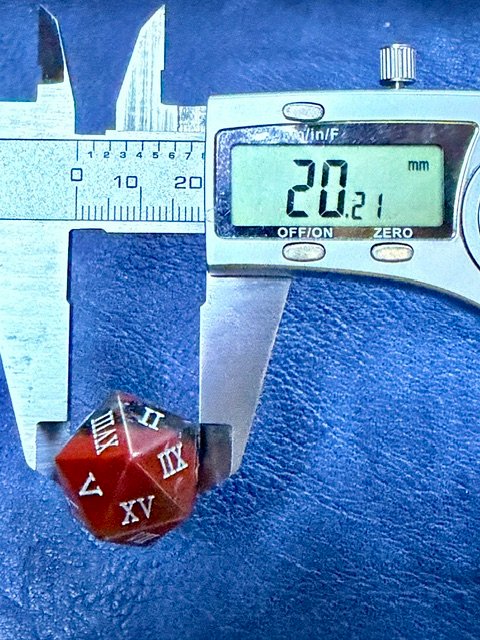
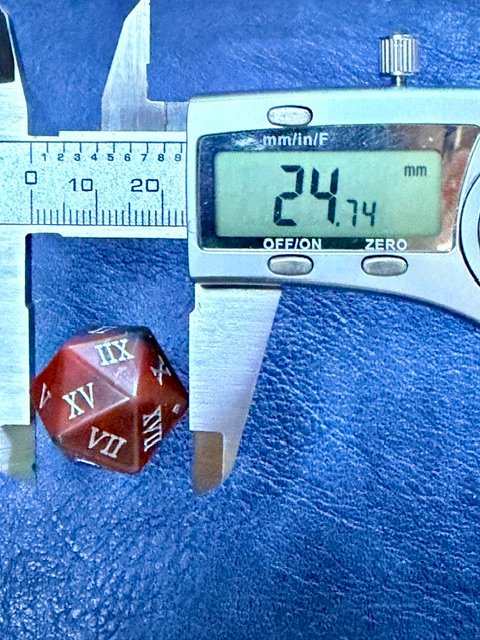
Size: (Face->Face) 20.21 mm (Point->Point) 24.74 mm
Where did it come from: Crystal Maggie
How much did it cost: $16.86
Material / colors: Bloodstone, brown and gray with silver numbers
Quality: Very good
Readability: Good (better if you can translate Roman Numerals quickly in your head)
Value: Very Good
Overall Rating: 8/10
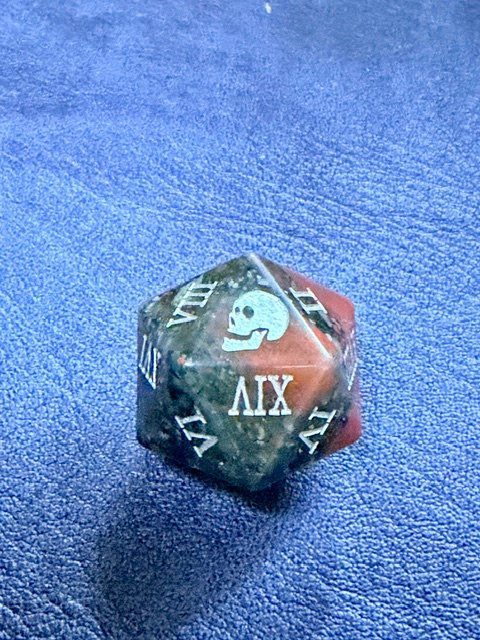
Attempts needed to roll a natural 💀: 4 rolls
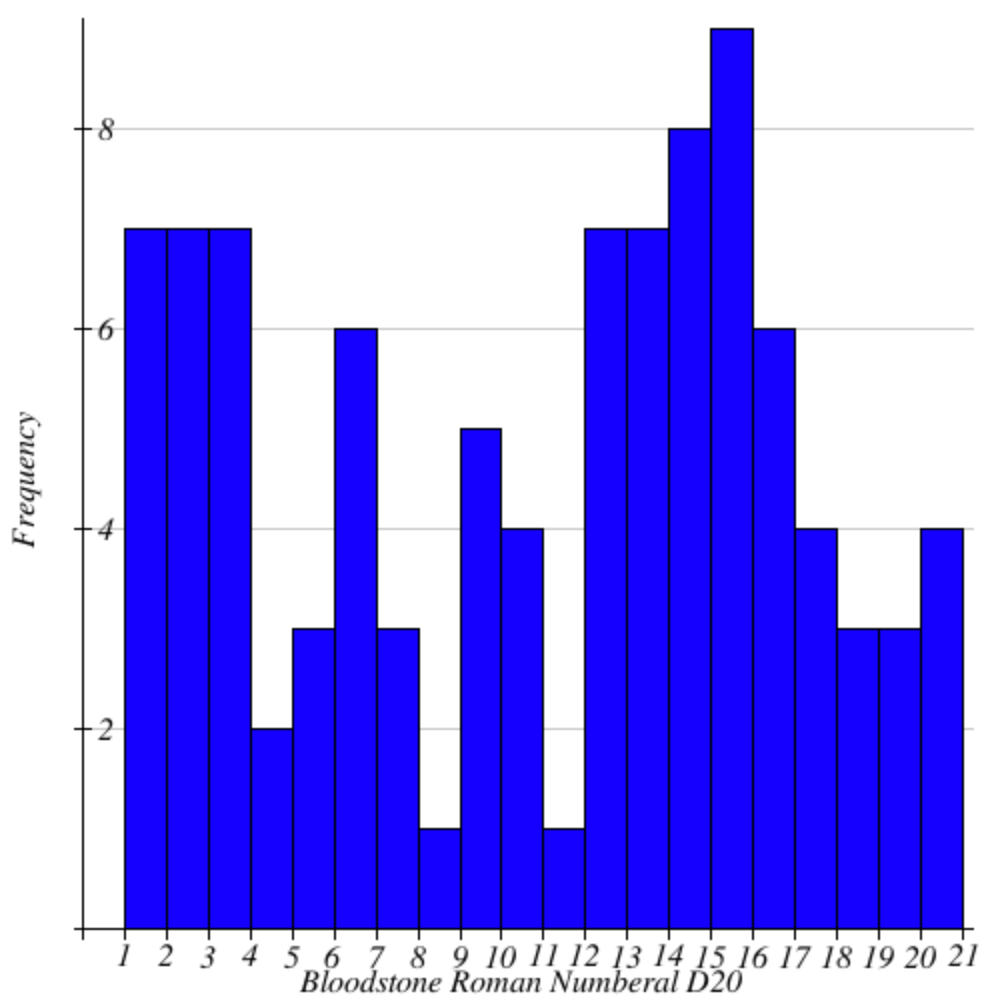
One Hundred d20 rolls: 13, 5, 12, 11, 10, 12, 2, 3, 16, 2, 6, 3, 12, 15, 7, 10, 6, 9, 16, 2, 1, 3, 19, 15, 18, 9, 20, 19, 13, 3, 14, 16, 17, 8, 8, 3, 2, 2, 9, 15, 17, 6, 14, 13, 3, 18, 14, 13, 15, 1, 14, 18, 14, 20, 9, 9, 13, 10, 16, 14, 8, 16, 12, 17, 6, 6, 8, 5, 17, 5, 15, 15, 3, 14, 15, 19, 2, 1, 13, 7, 15, 1, 2, 13, 10, 1, 14, 12, 15, 1, 4, 1, 16, 6, 7, 12, 12, 20, 4, 20
Mean: 10.27
Median: 12
Mode: 15
Chi-square: 18.400 **
Result: Balanced
6d20 drop 1s & 2s stat block: 11, 7, 13, 9, 9, 6 (55 total) A Chipper Goliath Barbarian from The Citadel who lost his shadow in a bet
For reference: the Standard Array method totals to: 72 and the Point Buy method totals to: 69.
A Variant Human Barbarian performing Athletics checks at each level from 1-20, taking the Skill Expert feat at level 1 for Athletics. All ASIs are used to get Strength to 20 as soon as possible. All athletics check rolls are made while raging (ie: with advantage)
Level 1: 1d20 + 1 + 4 = 21
Level 2: 1d20 + 1 + 4 = 9
Level 3: 1d20 + 1 + 4 = 15
Level 4: 1d20 + 2 + 4 = 21
Level 5: 1d20 + 2 + 6 = 26
Level 6: 1d20 + 2 + 6 = 9
Level 7: 1d20 + 2 + 6 = 14
Level 8: 1d20 + 3 + 6 = 21
Level 9: 1d20 + 2 + 8 = 18
Level 10: 1d20 + 2 + 8 = 28
Level 11: 1d20 + 2 + 8 = 29
Level 12: 1d20 + 4 + 8 = 27
Level 13: 1d20 + 2 + 10 = 30
Level 14: 1d20 + 2 + 10 = 22
Level 15: 1d20 + 2 + 10 = 26
Level 16: 1d20 + 5 + 10 = 30
Level 17: 1d20 + 5 + 12 = 24
Level 18: 1d20 + 5 + 12 = 37 *
Level 19: 1d20 + 5 + 12 = 24 *
Level 20: 1d20 + 7 + 12 = 43 *
* = Beginning at 18th level, if your total for a Strength check is less than your Strength score, you can use that score in place of the total.
Overall, this is one of the most possible scenarios that could happen with minimal min-maxing. Granted, all you’re doing here is making athletics checks… or maybe you’re grappling every opponent you face in combat.
Random Table Rolls (6 * d20):
Beneficial Potions and Elixirs: 45 – A Large, dead, hairy spider floating inside a vial of thick yellow liquid. This potion gives the drinker the ability to walk on vertical surfaces and upside down on ceilings as if granted the benefits of the Spiderclimb spell
Book Titles: 42 – Not Today: a satirical book written as a guide for the lazy Bard
(I’m in-between random table generators at the moment so I’m scrounging for tables wherever I can, mostly in books)
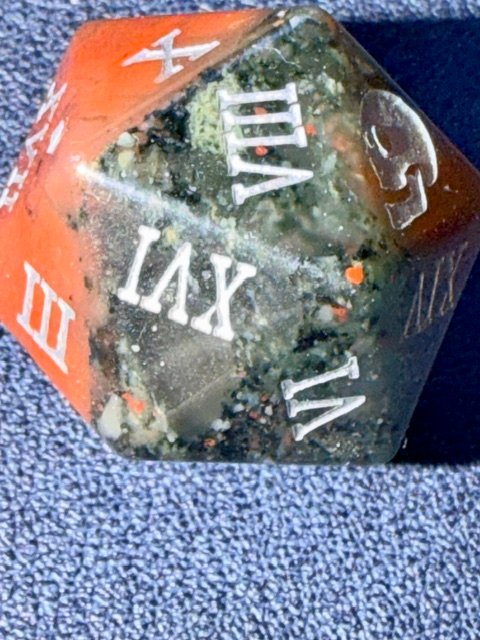
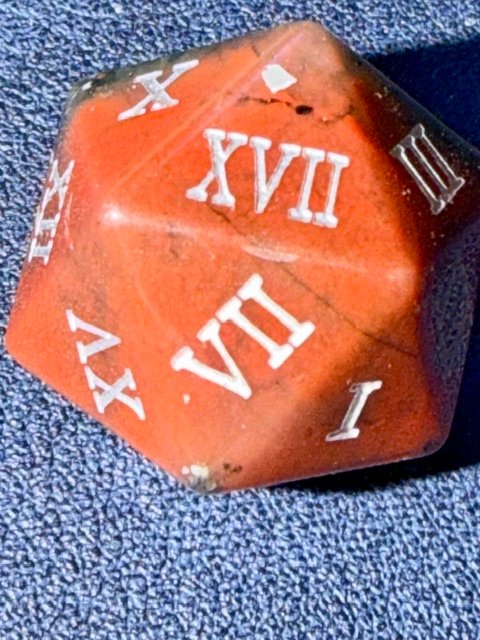
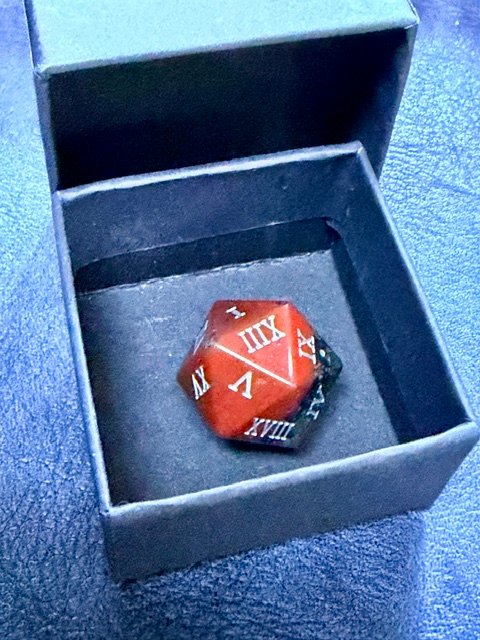
Final Thoughts: This die was an impulse buy. I was browsing for other dice online seeing if there were any interesting new dice that I didn’t currently own but needed to and I saw this one. A stone d20 that was numbered with Roman numerals. Somehow I’ve never seen dice with roman numerals on them. I play with a guy that has japanese (Kanji) numbers on one of his d20s to go with the theme of his Samurai fighter PC but I had yet to see Roman numerals. It’s stone, it was not very expensive, and it looked pretty good. The main detractor was that it has the profile of a skull on the 20 face. I did my best to look past that flaw and added to my online cart and in a couple of weeks it arrived in my mailbox.
It’s a bit jittery when it’s coming to a stop in my dice tray, and after cracking one of my first stone dice ever (A Lapis Lazuli d20 years ago) I’m trying to be extra careful with this stone die. I just looked up Bloodstone on the Mohs scale (mineral hardness scale) and Bloodstone comes in around 6.5 – 7 which is slightly higher than Lapis Lazuli but not quite as hard as Quartz. Bloodstone is on par with Peridot and Garnet hardness-wise. As long as I keep it in the tray when I roll it’ll be smooth sailing. I hoped that the color of the die would be closer to the dark green and red that the website photo showed, but I’m a realist and know that the websites are rarely accurate when it comes to color. Mine is grayish black and redish brown which doesn’t look nearly as nice as dark green and red.
The font is decent, it’s a very good fit for Roman numerals with the serifs on all three of the letters that are required to count from 1 – 20. (I, V, X). It’s a little bit funny to me that instead of having to use marks on the 6 and 9 faces to indicate orientation, that this set has to use marks on the 9 (IX) and 11 (XI) faces as those are the two numbers that can be interpreted correctly upside-down.
This d20 is pretty good but not great. If it didn’t have Roman numerals I wouldn’t have bought it. It’s a bit of a one-trick pony in that regard. I don’t know how much use this one will get at the table but I’ll try it out in my next session and see if I have many slip-ups due to my reading the numbers too fast. In my testing so far this die doesn’t feel very balanced but the Chi-square test says that I’m wrong. We’ll see
** I’ve added a new value to the reviews called “Pearson’s Chi-square Test” which is a calculation of the difference between of the number of times each value was rolled in the d20 roll test compared to the number of times each value would be rolled in a perfectly equal roll test. (perfectly equal means every value comes up the same number of times, or [total number of rolls / number of sides on the die]) Chi-square gives a sense of how far away from the statistical average the results of the d20 roll test were. It’s not a perfect measure of a die’s balance and fairness but it’s a good step in that direction. More information about die fairness / balance roll testing can be found here: https://rpg.stackexchange.com/questions/70802/how-can-i-test-whether-a-die-is-fair
Leave a Reply