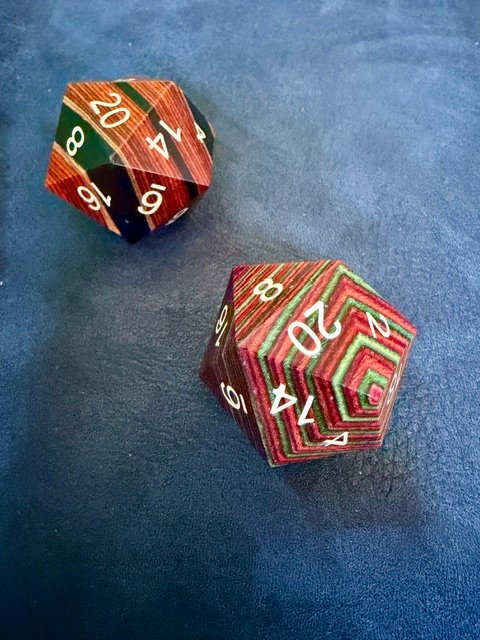
These dice are unbalanced, defy logic and possibly haunted… I’m so here for it!

Name: Two wooden d20s (?)
Description: I’m reviewing a pair of chonk d20s made of wood. I don’t know what kind of wood they’re made from or remember where I bought them. They were both milled from wood stock that was made up of many different pieces of wood pressed together. One d20 has brown and black wood, the other has brown, red, and green wood. Both d20s have relatively sharp edges and vertices for wooden dice. The numbers use a very classic font. It’s a dead ringer for Helvetica but I doubt that a small-time dice maker is paying licensing fees for the world’s most famous font. One of the best fonts if you care to ask me. The 6 and 9 faces use underbars (as <diety> intended) to indicate their orientation.
Size:
Brown / black d20: (Face->Face) 32.3mm (Point->Point) 40.2mm
Brown / red / green d20: (Face->Face) 33mm (Point->Point) 40.8mm
Where did they come from: I have no idea. I don’t see any trace of it in my Etsy purchase history, the problematic South American river-named company history, or in my email.
How much did they cost: $ Unknown. I see similar dice currently selling on Etsy for $20 each. I probably paid about $20 each.
Material / color: Wood. brown, black, red, and green
Quality: very good quality
Readability: incredibly good. 4 feet/8 feet/ 12 feet… no problem reading them.
Value: Great value
Overall Rating: 9/10


Attempts needed to roll a natural 20:
Brown/black d20: 1 roll
Brown/red/green d20: 1 roll
Insane, right? I rolled double nat 20s with my first roll of these dice in months.
Fifty d20 rolls:
Brown/black d20: 3, 4, 16, 16, 12, 8, 12, 9, 8, 18, 7, 19, 2, 3, 3, 3, 12, 9, 1, 6, 19, 15, 17, 4, 5, 14, 18, 16, 10, 18, 5, 16, 1, 3, 8, 4, 1, 13, 16, 5, 19, 3, 18, 9, 20, 8, 5, 6, 16, 3
Mean: 9.86 (Average roll)
Median: 9 (Middle)
Mode: 3 (most common)

Brown/red/green d20: 2, 9, 13, 9, 16, 11, 13, 17, 13, 5, 5, 3, 4, 19, 10, 3, 19, 8, 14, 2, 1, 7, 6, 10, 7, 9, 3, 15, 3, 3, 3, 2, 19, 5, 2, 12, 11, 13, 9, 14, 8, 3, 20, 1, 5, 19, 9, 8, 8, 14
Mean: 8.88 (Average roll)
Median: 8.5 (Middle)
Mode: 3 (most common)

6d20 (re-roll a 1 or a 2) stat block:
Brown/black d20: 17, 20, 10, 6, 8, 16 (77 total) A Pensive Elf Rogue from the city sewers who has accepted death as an inevitability
Brown/red/green d20: 6, 8, 4, 13, 16, 15 (62 total) A Stoic Dwarf Cleric from the strongest family heritage line in the land who always cuts to the chase
For reference: the Standard Array method totals to: 72 and the Point Buy method totals to: 69.
5 attacks at advantage from the 20th level Rogue (brown/black die):
25, 26, 20, 22, 17
5 Concentration checks from the 20th level Cleric who has the War caster feat: (Brown/red/green d20): 19, 27, 16, 17, 23
(This is another excuse for rolling dice)
Random Tables rolls: (6 x d20, one with each d20)
Encounters in an ancient crypt: 61 – The players come across a large chamber filled with old and rotted furniture, including an ornate throne in its center. Sitting upon it is a skeletal figure wearing tattered robes, holding a staff in one hand and a cracked skull in the other. Upon closer inspection, the skeleton is revealed to be an ancient Lich who was once the ruler of this crypt. It will challenge any intruders to answer three riddles before it will allow them passage through its chamber.
Small Familiars: 30 – A penguin. It may or may not be hiding an egg between its legs. The egg may or may not be a penguin.
(I’m getting these random tables at: https://d100tables.com by the way


Final Thoughts: I love the way that these dice look. The striped wood with the fine sandwiched layers and the one of the world’s best fonts inked in a super-readable white color. So why don’t I use these dice more at my in-person game? Because they’re really light for their size. I have a few dozen chonk d20s in the 30mm – 40mm size range and these are much lighter than all of them except for maybe my ceramic d20. I like dice to have weight and these are lighter than all of my resin or metal d20s. These dice sound great when you’re shaking them both up in your hand getting ready to roll them though. Wood on wood clacks in its own unique way.
The dice have some kind of finish on them, I don’t know if it’s lacquer, wax, or something else, but it’s very protective and has kept these dice in good condition since I bought them at least 2 years ago. These dice always get an “ooh” when new people see them at the table but I still feel underwhelmed by them. They don’t roll particularly well, although this is the first time I’ve ever rolled two nat-20s on a 2 dice roll. What I wouldn’t do for that to happen at my in-person game. Rolling for some critical check at disadvantage and you throw two 20s? That’s the stuff of legend. That’s CR / Dimension 20 territory. I think I’ve seen this happen twice on CR in the hundreds of hours I’ve watched of that show. As the histograms above show though, 3 is the most common number that these dice are landing on. That’d be pretty terrible to bring to a game. With a natural 1 you can RP a fun failure but with a 3 you just hang your head and start thinking about dice jail.
Okay, speaking of rolling threes, It sounds like I’m making this up and I still don’t know what to believe about how it happened but after typing that last paragraph, I rolled both dice on the pad of paper sitting next to me and I rolled: double 3s. What the actual fuck!? Maybe I do need to take these dice with me every week and only pull them out for rolls I have to make at advantage or disadvantage. I understand if a die is imbalanced to bias toward a number, but for two similar dice to be biased toward the same number and have matching rolls more than once in a day is beyond bizarre.

Now I’m really curious, so here are 10 double d20 rolls to see what happens:
9, 16
15, 17
13, 18
5, 2
7, 11
10, 8
5, 11
19, 17
16, 2
20, 10
That seems like a totally normal spread of rolls.
I should have put the dice away but I pushed my luck and rolled 2 more times saying aloud: “what if I roll double threes?” before each roll:
4, 3
20, 20
Yep. another double nat-20. something is very wrong with these dice and I’m here for it!

Addendum (9/22/26) … I used these dice to make 2 attacks in a recent in-person D&D session with my awesome group and rolled 2 natural 20s for the attacks on my turn. I absolutely demolished the baddie that I was attacking and got a few gasps at the table.
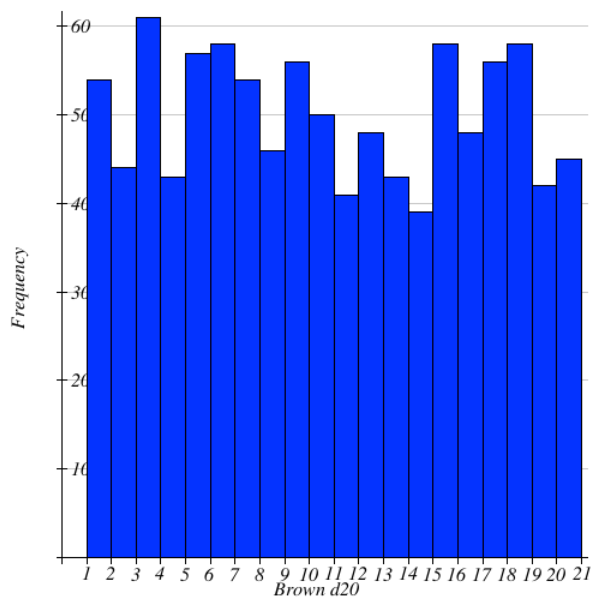
Being me, I felt immediately bad about the rolls given the history of these dice. I decided that I won’t be using these dice for attack rolls… except maybe in the most dire circumstances in the future. A few days later, I was organizing my D&D bag and took these two dice out and it only took 4 rolls at advantage (rolling them both at the same time) to roll another pair of natural 20s. I don’t know what’s up with these dice so I did a 1000 roll test for each of them over the next 2 days and calculated some basic statistics on the roll data (shown below) and graphed the datasets.
I also went back and calculated the Chi Square value for the two 50-roll datasets above that I’d done for this review originally. Based on those initial 50 rolls, both of the dice have Chi Square values that point to them being unbalanced. Unfortunately 50 rolls isn’t enough to calculate a reliable Chi Square value. You shouldn’t use less than (# of sides x 5) rolls for your dataset. This is why I switched to 100 roll tests for my d20 reviews a while back. That’s the minimum number of rolls to have any confidence in your calculations.
I’m actually surprised that the 1000 roll dataset that I just performed didn’t show that the dice were skewed / unbalanced. Maybe I need to consider a float test for these two…
Brown D20 (1000 rolls):
Mean: 10.7625
Median: 10
Mode: 3
Chi Square: 18.480 **
Result: Balanced
Striped D20 (1000 rolls):
Mean: 10.569
Median: 11
Mode: 19
Chi Square: 25.960 **
Result: Balanced
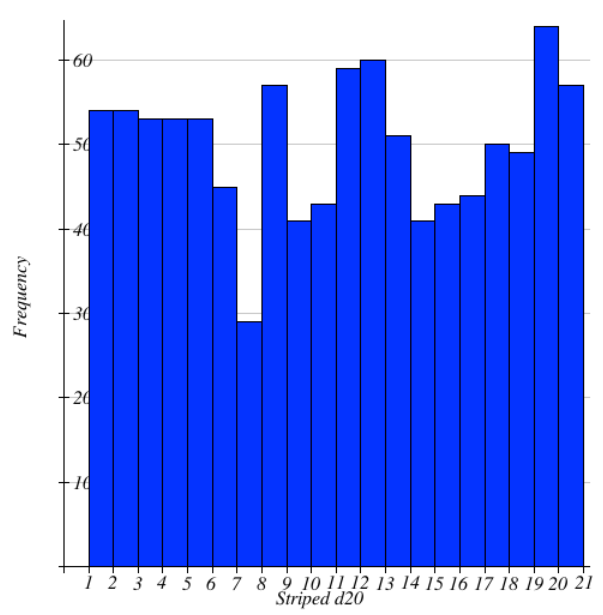
** I’ve added a new value to the reviews called “Pearson’s Chi-square Test” which is a calculation of the difference between of the number of times each value was rolled in the d20 roll test compared to the number of times each value would be rolled in a perfectly equal roll test. (perfectly equal means every value comes up the same number of times, or [total number of rolls / number of sides on the die]) Chi-square gives a sense of how far away from the statistical average the results of the d20 roll test were. It’s not a perfect measure of a die’s balance and fairness but it’s a good step in that direction. More information about die fairness / balance roll testing can be found here: https://rpg.stackexchange.com/questions/70802/how-can-i-test-whether-a-die-is-fair
Leave a Reply