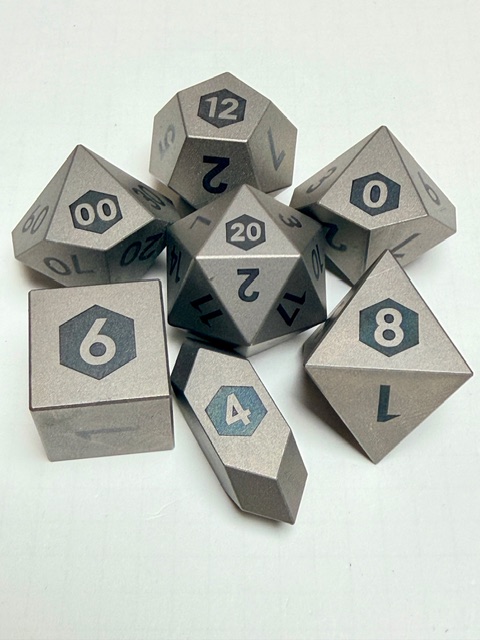
Titanium dice. Precision made from Flying Horseduck. Expensive and gorgeous just as you’d expect.
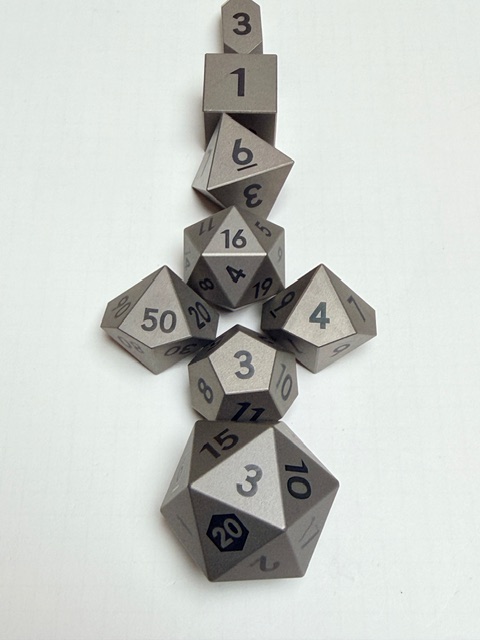
Name: Honest Dice Titanium set plus extra Chonk d20
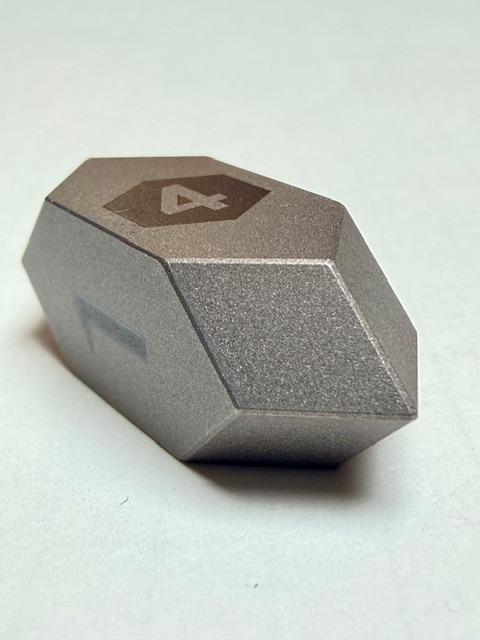
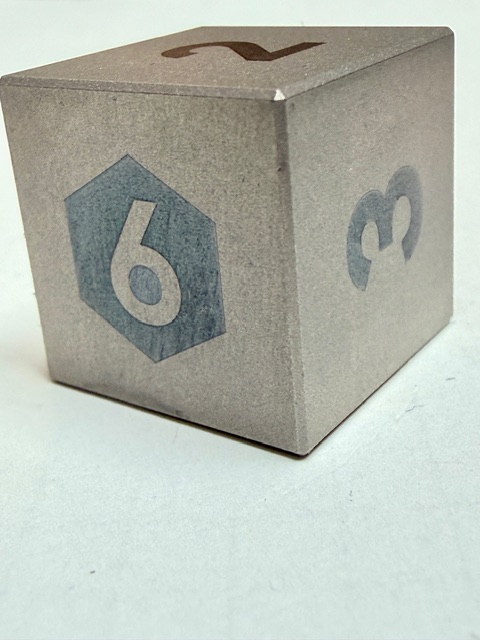
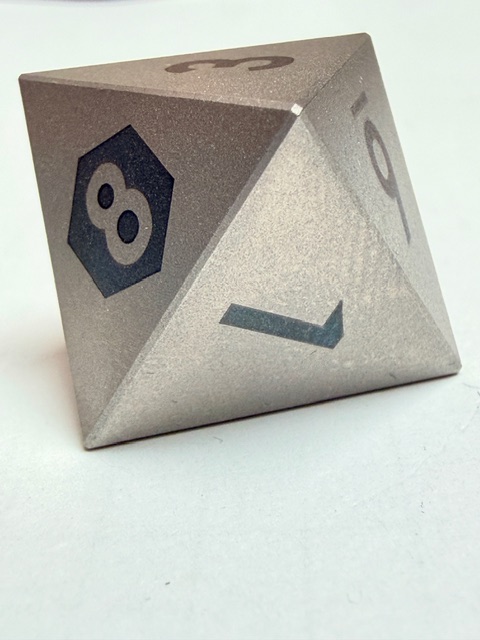
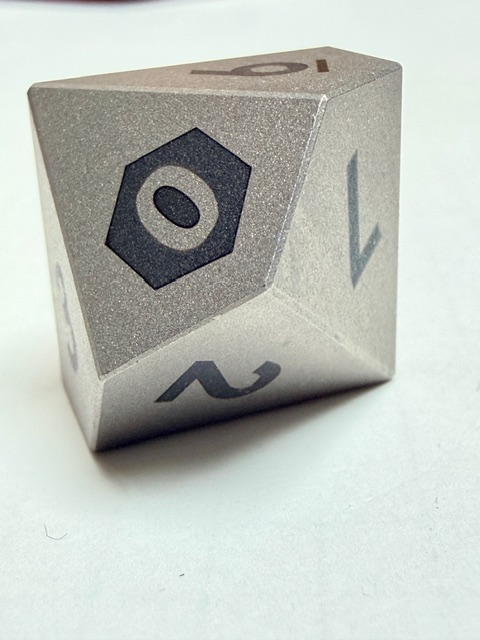
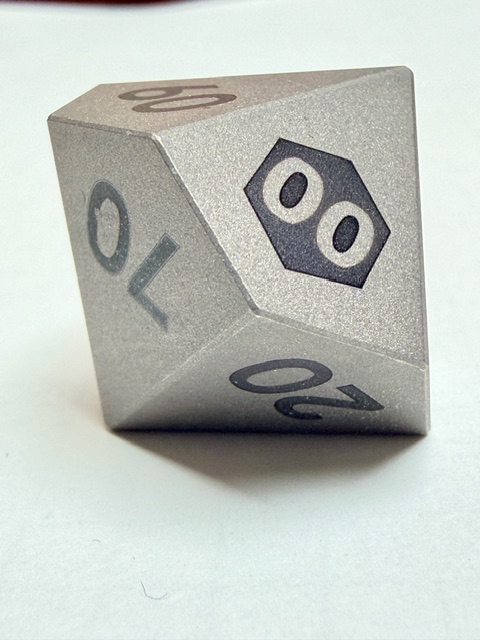
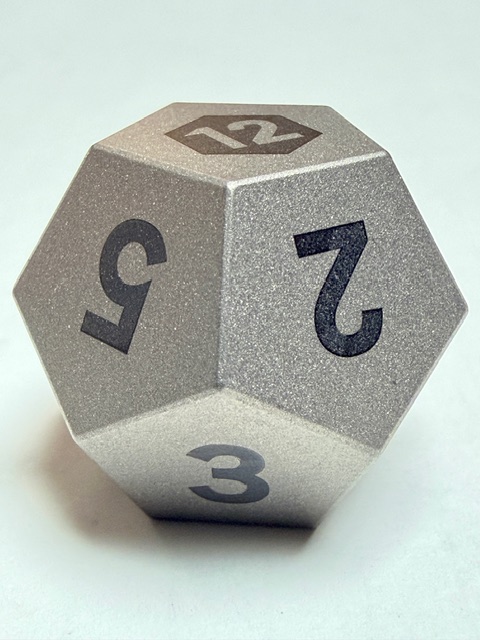
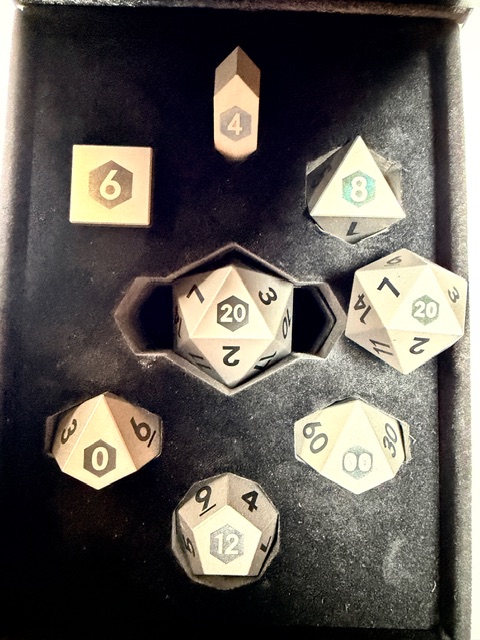
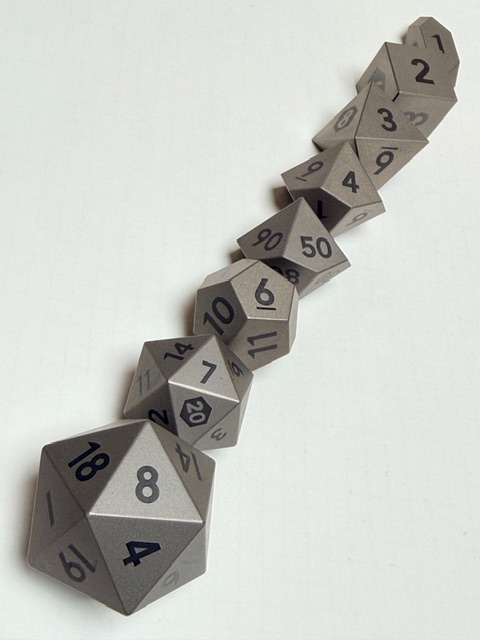
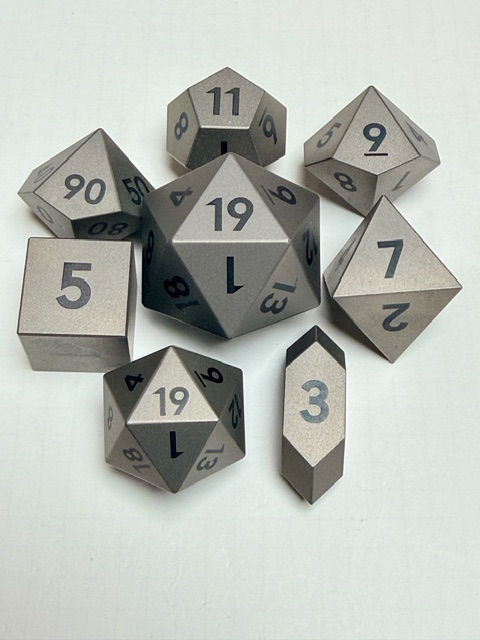
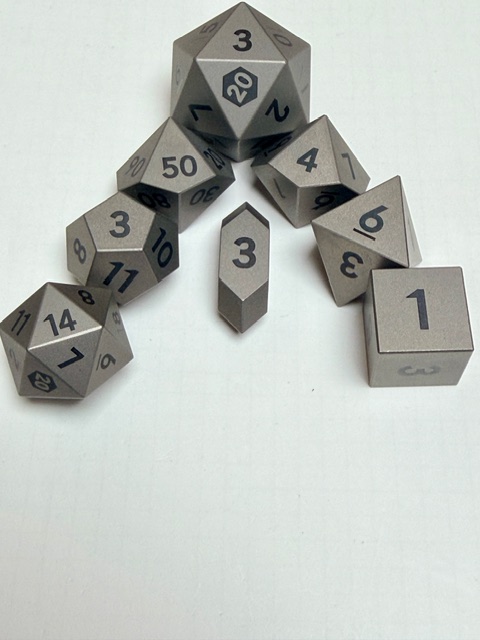
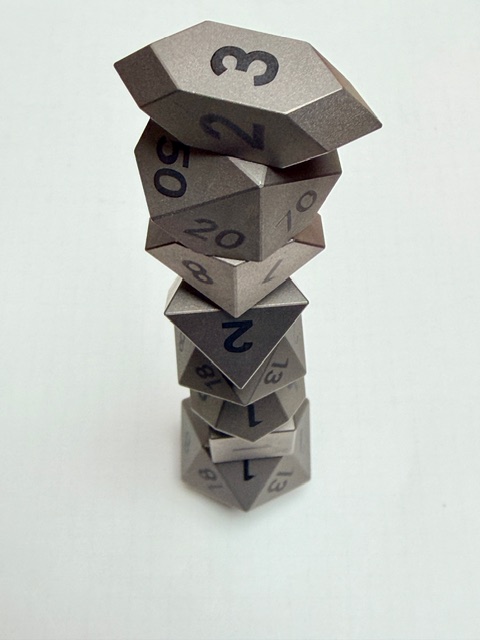
Description: This is a set of seven oversized near-sharp edge Titanium dice and one chonk Titanium d20 in a natural gray Titanium color. The dice are all standard shapes except for the d4 which is a unique “Hex d4” shape. The font is a modified custom font “based on the Futura typeface” according to Flying Horseduck. The high faces on each die have a laser etched hexagon with the number of that face un-etched (negative space) inside. The 6 and 9 faces use underbars to indicate their orientation. The dice came nice faux-leather boxes with magnet lids and firm foam inserts with cutouts for the dice to fit very snugly.
Sizes:
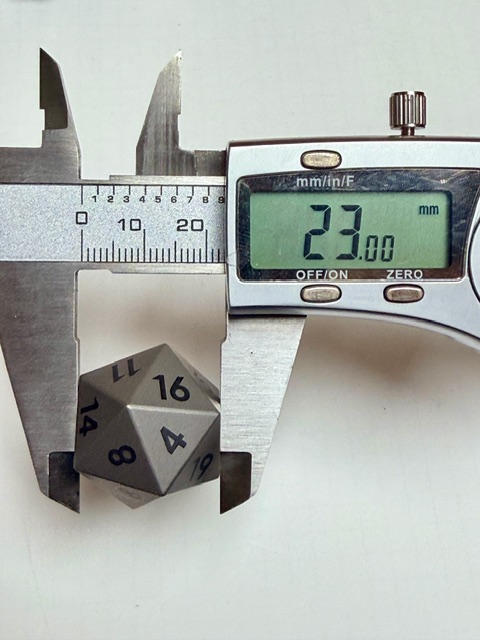
Standard d20: (Face->Face) 23.00 mm (Point->Point) 28.37 mm
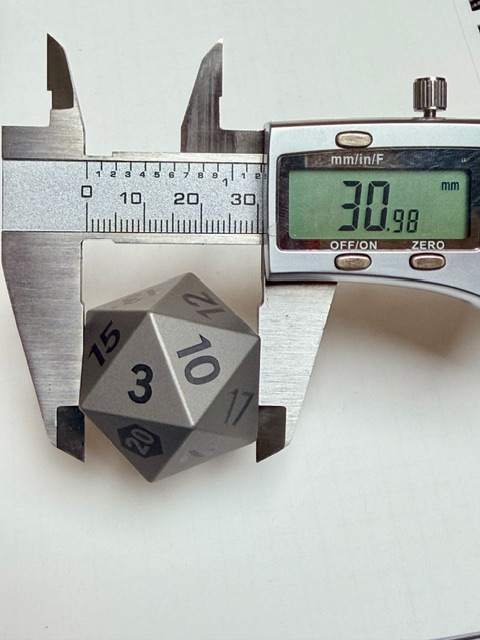
Standard d20: (Face->Face) 30.98 mm (Point->Point) 38.17 mm
Where did they come from: Flying Horseduck on Kickstarter
How much did they cost: $449 for the 7 die set!!!! and $109 for the chonk d20. (hangs head)
Material / color: Ti-6Al-4V Titanium / gray (silvery-grey-white) with black numbers
Quality: Incredible!
Readability: Excellent!
Value: Not very good. I’m trying not to think about that.
Overall Rating: 10/10 (should be 12/10)
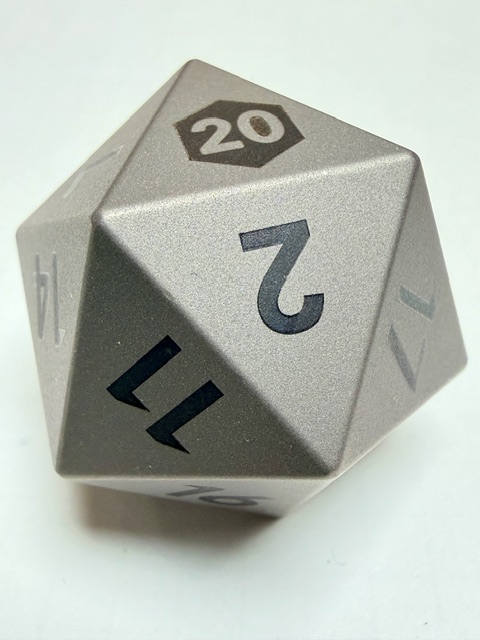
Attempts needed to roll a natural 20
Standard d20: 52 rolls
Chonk d20: 20 rolls
One Hundred rolls (standard size d20): 18, 1, 18, 10, 13, 11, 8, 4, 2, 11, 2, 3, 13, 17, 12, 19, 13, 15, 2, 2, 8, 6, 13, 3, 3, 19, 15, 16, 1, 19, 4, 12, 10, 3, 13, 7, 6, 16, 2, 1, 12, 13, 13, 2, 2, 18, 11, 4, 17, 8, 9, 15, 2, 14, 13, 13, 20, 10, 5, 11, 14, 9, 15, 15, 10, 6, 3, 14, 19, 2, 18, 9, 20, 6, 3, 6, 14, 4, 3, 3, 18, 2, 18, 9, 16, 20, 14, 16, 11, 8, 9, 9, 4, 3, 4, 12, 13, 14, 13, 8
Mean: 9.97
Median: 10.5
Mode: 13

One Hundred rolls (chonk d20): 5, 2, 8, 14, 3, 4, 15, 3, 19, 16, 4, 19, 16, 16, 5, 1, 17, 7, 14, 12, 10, 6, 8, 10, 10, 6, 9, 11, 16, 8, 17, 1, 5, 3, 11, 2, 14, 9, 17, 6, 10, 19, 2, 14, 1, 2, 16, 5, 14, 14, 2, 9, 4, 5, 4, 17, 9, 13, 8, 16, 10, 11, 13, 9, 12, 13, 10, 5, 17, 7, 18, 8, 17, 8, 14, 3, 18, 10, 2, 13, 18, 7, 16, 8, 13, 4, 7, 1, 13, 14, 19, 1, 11, 19, 4, 1, 1, 7, 3, 19
Mean: 9.67
Median: 9.5
Mode: 14

4d6 drop 1 stat block: 13, 9, 9, 12, 14, 6 (63 total) A Helpful Tiefling Wizard from a fallen kingdom who started a rebellion in the northern mountains.
For reference: the Standard Array method totals to: 72 and the Point Buy method totals to: 69.
A 20th level Wizard with maxed INT comparing damage for her 9th level spells:
Abi-Dalzim’s Horrid Wilting (12d8 vs 19 CON save): 4 FAIL: = 67 damage
Blades of Disaster: (4d12 / attack w/ crits on 18+): 111 damage total:
Attack 1: 8 + 11 = 19 HIT: 4d12 = 39 damage
Attack 2: 19 + 11 = 20 CRIT: 12d12 = 72 damage
Meteor Swarm: (40d6 vs 19 DEX save): 20 SAVE: 135 / 2 = 67 damage
Psychic Scream: (14d6 & stunned vs 19 INT save): 1 FAIL: 47 damage & stunned
Ravenous Void: (5d10 & restrained vs 19 STR save): 12 FAIL: 24 damage / rd
Time Ravage: (10d12 vs 19 CON save): 20 SAVE: 75 / 2 = 37 damage
Weird: (4d10 vs 19 WIS save): 16 FAIL: = 34 damage / rd
This isn’t an ideal comparison of the damage that the spells do as some of them affect a single creature, some can affect a number of creatures and some affect everyone within an area. Was it fun to roll up damage with my new dice though?It certainly was!
Bonus test: How long will it take for my 10th level Peace Cleric to recover from his three levels of exhaustion: 3 attempts (I rolled 00 & 2)
Random Tables rolls:
City Quests: – 71 A statue in the town square has disappeared overnight and footprints (apparently from the statue) are found leading to the Magicians’ quarter. It could be a prank or something more sinister.
Searching the Alchemy Room: – 98 Potion of Healing – Regains 2d4 + 2 HP
(I’m getting these random tables at: https://d100tables.com by the way
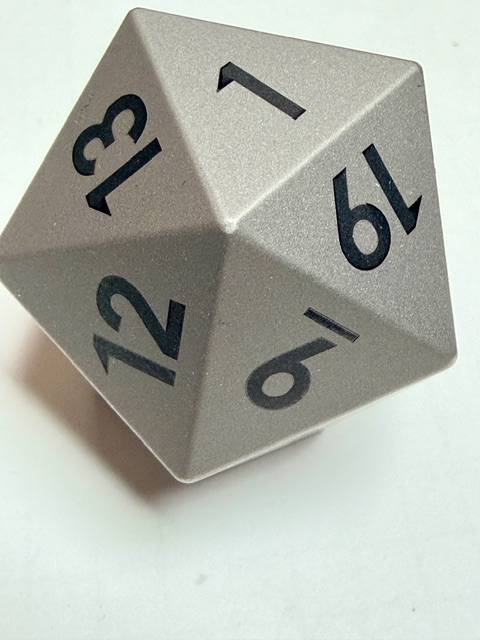
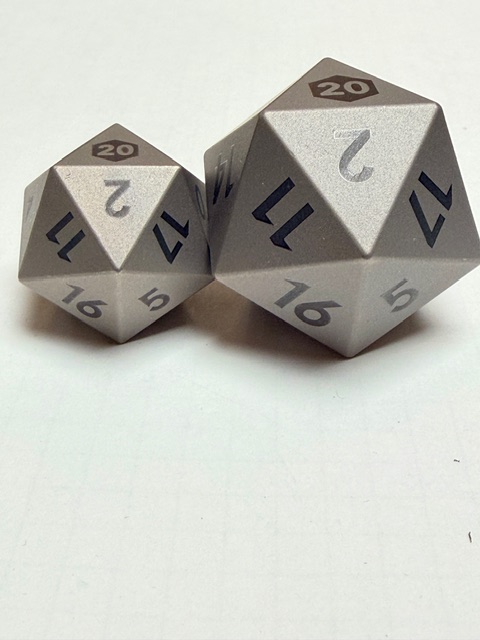
Final Thoughts: These dice are from a Kickstarter campaign that I backed in March 2025. I’ve been (mostly) patiently waiting for them to arrive. This is the 3rd campaign from the same dice maker (Flying Horseduck) that I’ve backed on Kickstarter and all of them have exceeded my expectations. The quality of their dice is top of the charts. They’re expensive but they’re so well made and beautiful that I was willing to back them.
I love finding dice made of new materials beyond resin and Zinc. I’d have to say that Titanium dice were not on my radar at all. Titanium is not a material that I had ever seen used by dice makers before. I imagine that it’s due to the cost and difficulty of working with Titanium. I have seen dice made from Tungsten though, and I would love to get a set of those but they’ve always been very expensive and never very fancy. Just looking on Norse Foundary now and they have both Tungsten dice ($650/set) and Titanium dice ($575/set). The Titanium set they sell costs $126 more than this set of dice and are not nearly as nice at these. The Norse Foundry Titanium dice have rounded edges, carved unpainted numbers, and are significantly smaller than this set. The Tungsten set look the same as their Titanium set. If I were going to buy a set of dice for that much money, they’d better be gorgeous to look at as well.
Back to these Flying Horseduck dice… They are large, heavy, very sleek in their styling, and have an easy to read font that fits with the minimalist look that they were going for. These dice have gorgeous beveled edges and very clean lines that come together with tight tolerances and accuracy. They’re not sharp but not very dull either. The flat gray of the Titanium and deep black color of the numbers goes together well enough that I can enjoy the look despite being a person who very much prefers to buy colorful things, especially dice.
This set of dice is different than most dice sets in a few subtle ways:
– They use a “Hex” d4 shape instead of the standard tetrahedron (3 sided pyramid)
– They indicate the highest number or each die with a black hexagon and the number cut out of it in negative space
– The dice don’t use the standard numbering pattern where opposite sides of each die sum up to the number of sides + 1
I wrote much more deeply about these three things in the previous dice post: #108 “Fine Line”.
I’m not convinced of the balance of the dice though. It could be that my methods of dice roll testing are not scientific enough (shaking the die around in my hand a few times and then throwing it in a wooden dice tray, sometimes rebounding off of the walls). Neither of the 100 roll tests I performed above were very impressive in the balance of their results. I’m going to do a larger test for each of the four d20s that I bought from this Kickstarter campaign from Flying Horseduck (yes, there’s still one review to come) and see if the results settle over a larger sample. If I plot just the first 50 rolls of both of the d20 tests, the results are even more skewed, especially in the case of the standard d20.
Aesthetically these dice are rare beauties in form though maybe not in color. There’s nothing wrong with the muted colors, or rather the absence of color however. The size of this set of dice is perfect for my preferences. Big enough that they feel heavy and substantial in your hand, easy to pick up, and easier to read with the larger faces. These dice are made from Ti-6Al-4V Titanium which is more than 50% denser than Aluminum. This type of Titanium boasts a range of 300 – 390 on the Brinell hardness scale. The 7075 Aluminum dice that are featured in the previous review come in at 130 – 150 on that hardness scale. Stainless Steel is generally in the 130 – 290 range on the Brinell scale. This set of dice is made from space-grade Titanium which means that they’d be very difficult for me to damage… even with a sledgehammer.
According to the Kickstarter campaign information, these dice were made with a 5-axis CNC (Computer Numerical Control) milling machine. They were carved by the CNC mill one die at a time. CNC machines are well known for their precision and accuracy. I hope that Flying Horseduck made extra Titanium dice to sell in their store (honestdice.com) like they have for their previous Kickstarter dice campaigns. With such a high materials cost for Titanium, I doubt that they made very many extra dice.
How do they roll? The d20s are heavy enough that they wander a tiny bit at the end of a roll as they’re settling and they have a little shake as they finish. I don’t remember any other dice that have the shimmy at the end of a roll like this. These d20s also seem to be more prone to getting cocked against the side wall of my wooden dice tray than most of my other d20s. This isn’t a complaint though, just an observation. I love rolling these beauties.
These dice definitely are a luxury and are by-far the most expensive dice I’ve ever bought. The timing of the kickstarter campaign worked out perfectly with my ability to afford such a set of dice… for a game. I feel a little shame spending what I did on these dice (even though I spread it out over 4 payments) now that I think about. They are just so gorgeous and as far as I can tell, perfectly executed. I’m not going to make any recommendations about these dice. I’ll just say that they’re very very fancy dice and I’m lucky to own them.
UPDATE: I performed a 1000 roll test with both the standard size and the chonk d20 (my arm is actually a little bit sore). I don’t have a dice tower that the d20s can fit through so I just shook the die up in my hand(s) and dumped them into my wooden dice tray. Some rolls just stopped when they landed, some rolled across the tray, some bounced off of the walls of the tray before stopping. The smaller d20 gets cocked against the walls of the tray easier than I’d expect probably due to the weight / density. Anyway, what I’m getting it is that this wasn’t a very controlled or scientific test. I just shook the dice up and rolled them like I would in-game. Here are the stats and histograms of the rolls:
Rolls: 1000
Standard d20:
Mean: 10.322
Median: 10
Mode = 3, 6
Standard Deviation: 5.7911876
Variance: 33.5378539
Chonk d20:
Mean: 10.521
Median: 11
Mode = 3
Standard Deviation: 5.8274796
Variance: 33.9595185
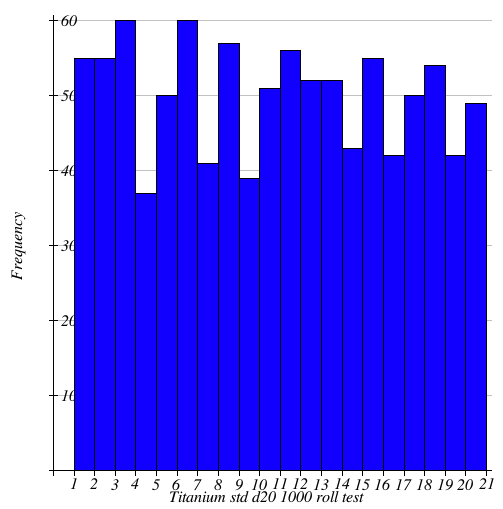
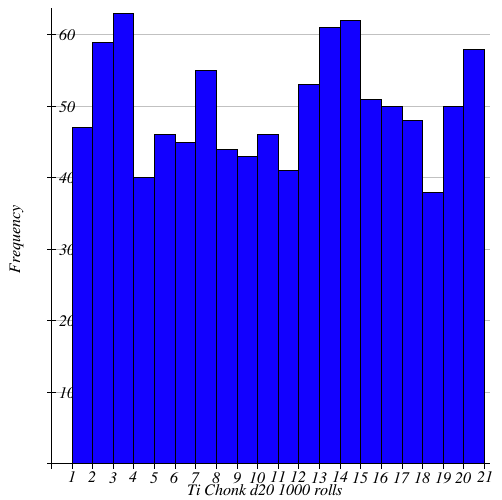
In a perfect scenario each number would be nearly the same in its frequency with the mean (average) roll being around 10.5. At 10.322, the standard size d20 is very close. The Chonk d20 is spot-on with a 10.521 mean.
As I mentioned in a previous post, I’m a nerd so of course I dug deeper and looked at this Stackexchange post answering the question: “How can I test whether a die is fair?”
The method described involves comparing your distribution of rolls against what a completely balanced die would be (each face coming up the same number of times). Next you determine the difference between the actual number of rolls for each face and the theoretical balanced average # of rolls. You then square that difference and divide it by the theoretical average. You do this for each die value and then and then add all 20 of these calculated variances to come up with a total variance value (Chi-square).
Introductory statistics course definition incoming:
A Chi-square (𝜒2) test is a non-parametric statistical method used to analyze categorical data by comparing observed frequencies in a sample with expected frequencies. It determines if differences between expected and observed data are due to chance or a significant relationship.
Example: actual theoretical diff diff sq /
Face rolls average diff squared theo. avg
1 38 50 12 144 2.88
2 61 50 11 122 2.44
3 52 50 2 4 0.08
4 44 50 6 36 0.72
5 58 50 8 64 1.28
6 41 50 9 81 1.62
. . 50 . . .
. . 50 . . .
. . 50 . . .
20 31 50 19 361 7.22
Total: 1000 1000 16.24 (Chi-square)
The table above is incomplete (missing data for faces 7 – 19). For a d20 die to be considered balanced, the number in the bottom of the rightmost column (Chi-square) needs to stay under 27.204. Small and even medium differences between the actual # of rolls and the theoretical average number of rolls don’t inflate Chi-square very much. However in the last row of the data (20 face) a difference of 19 between the actual # of rolls and the theoretical average made a significant difference, adding 7.22 to Chi-square.
Based on the degrees of freedom that your die has (19 DoF for a d20), you look up your Chi-square value in a table and see how much variability is considered “fair” at different probability levels. Probability less than the critical value
DoF 0.90 0.95 0.975 0.99 0.999
----------------------------------------------------------
19 27.204 30.144 32.852 36.191 43.820
After doing the calculations for my 1,000 roll d20 tests, I calculated the following Chi-square values for each die:
Standard Titanium d20: 18.68
Chonk Titanium d20: 21.88
Both Chi-square values are below the threshold for the .90 probability column (27.204) in the chart excerpt that I posted just above. This means that with their Chi Square values being less than 27.204 these two dice probably have no bias.
What’s shocking to me is that the top two histograms above of the 100 roll tests (which both look very unbalanced with big mountains and valleys) show that the Chi-square numbers for the dice were only 26.8 (standard d20) and 13.0 (chonk d20). Both of those values are under the 0.90 probability number indicating the high degree of certainty that they are well balanced dice. The more rolls of a die there are in your sample data, the higher the confidence level whether the die is balanced or not. Also, just looking at histograms can be deceiving.
To put a bow on all of this, The results of the 1000 roll test hold true to the “Honest Dice” moniker that Flying Horseduck has adopted. Fair play. Flying Horseduck, fair play.
Leave a Reply