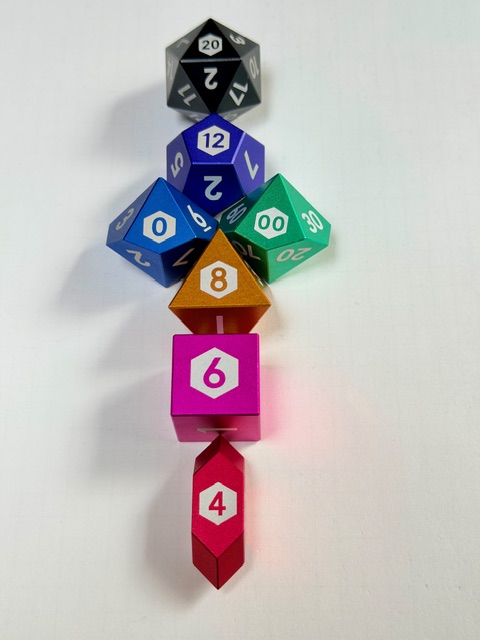
It’s Xmas in February with this long awaited Aluminum rainbow set from Flying Horseduck
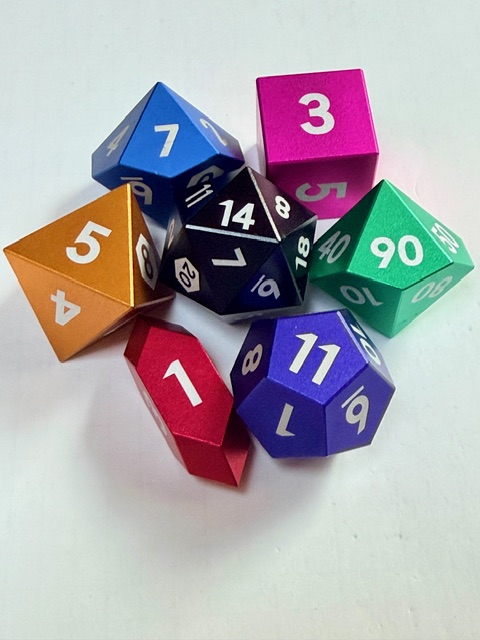
Name: Honest Dice Aluminum rainbow set
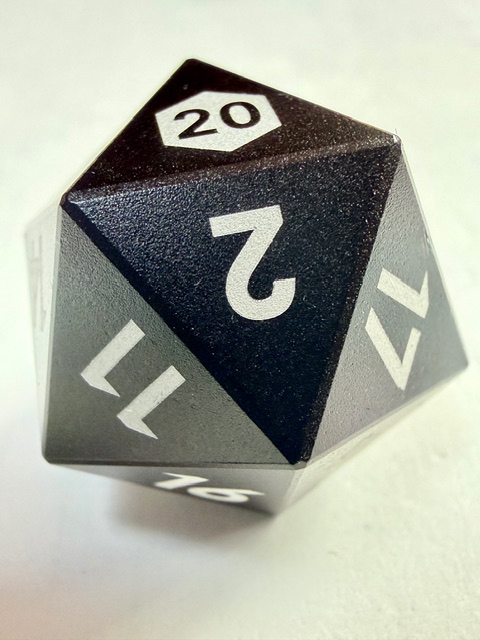
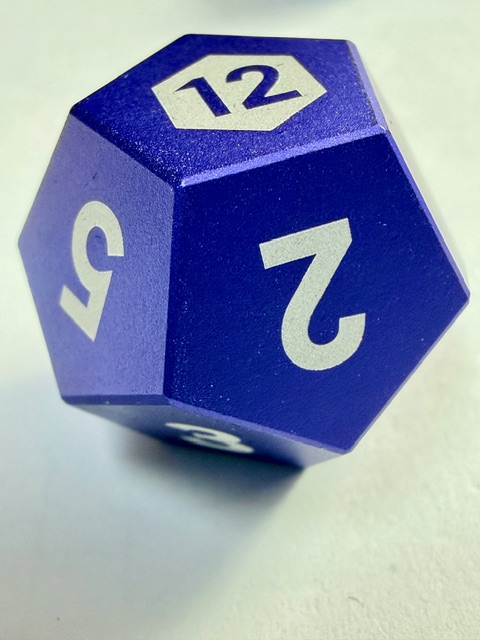
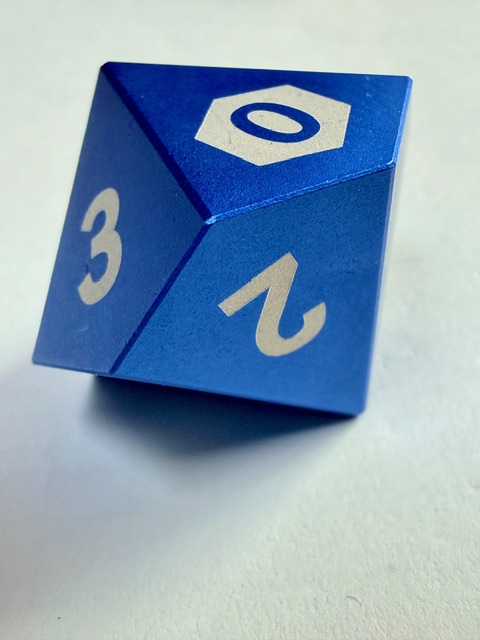
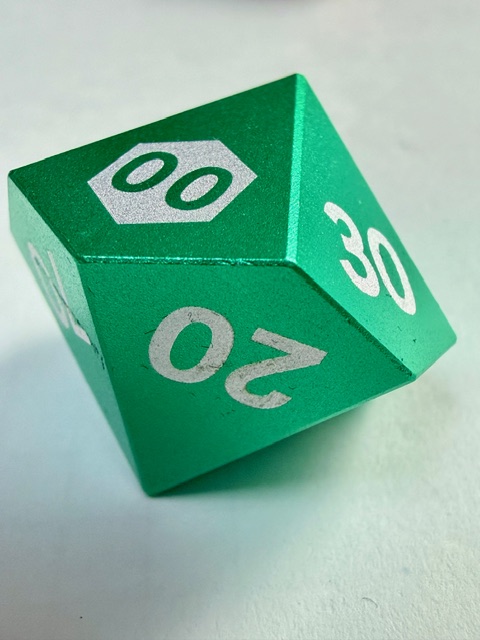
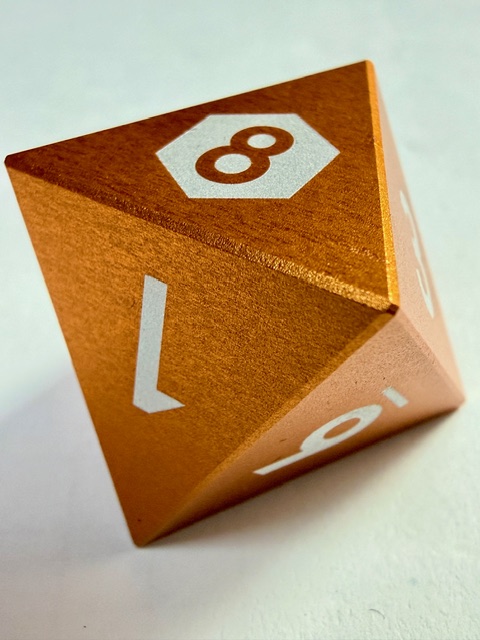
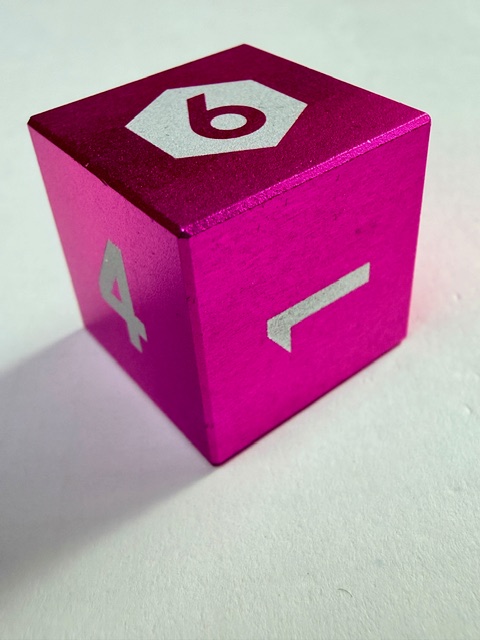
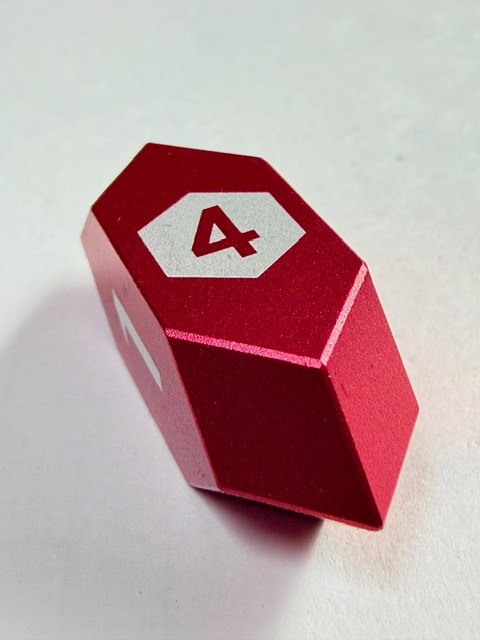
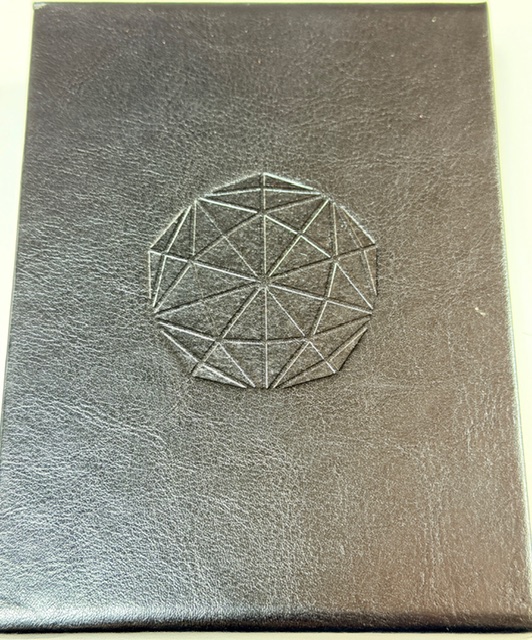
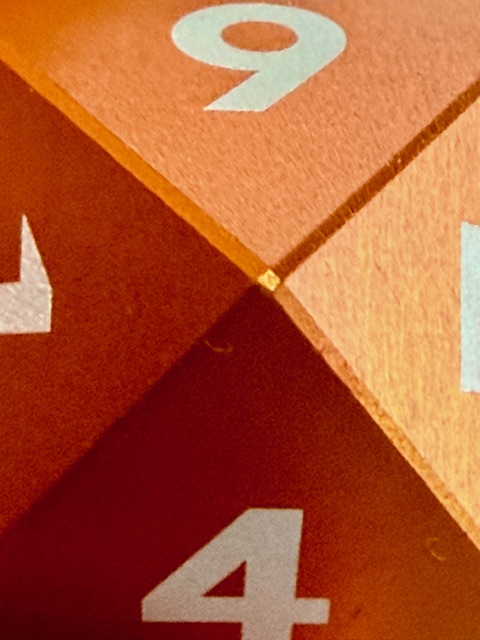
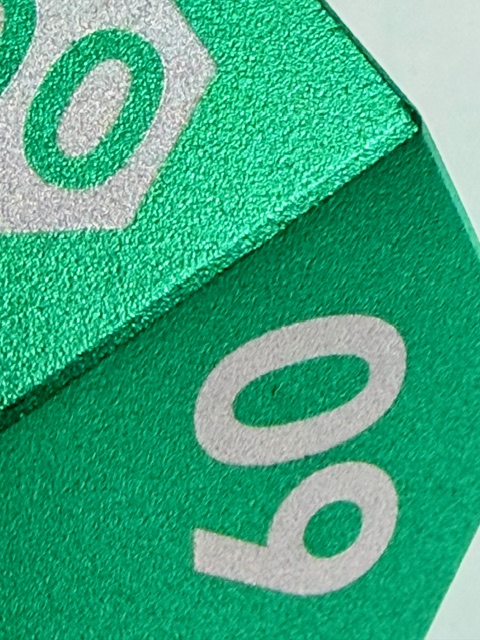
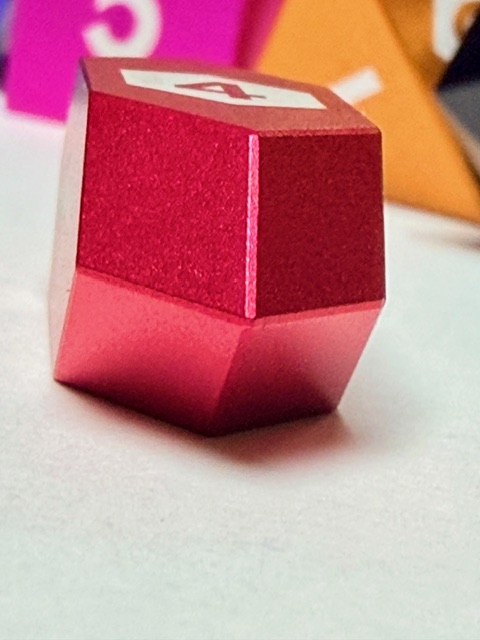
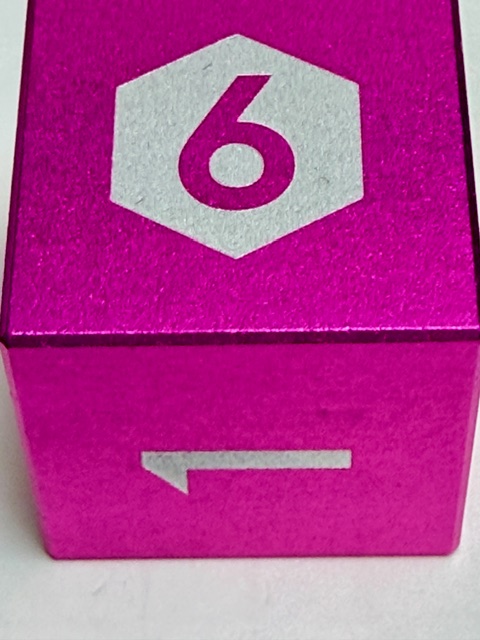
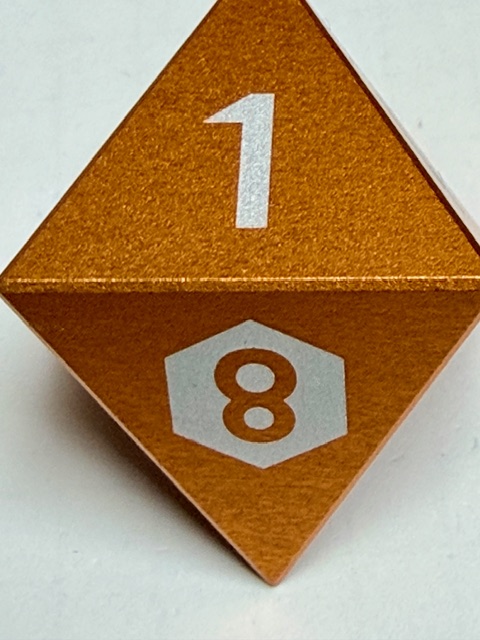
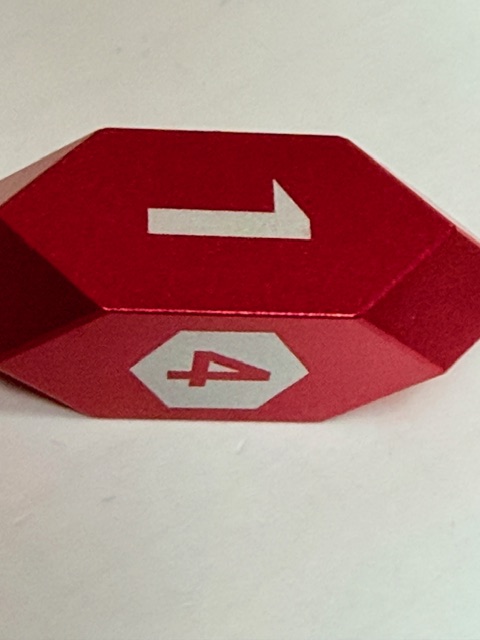
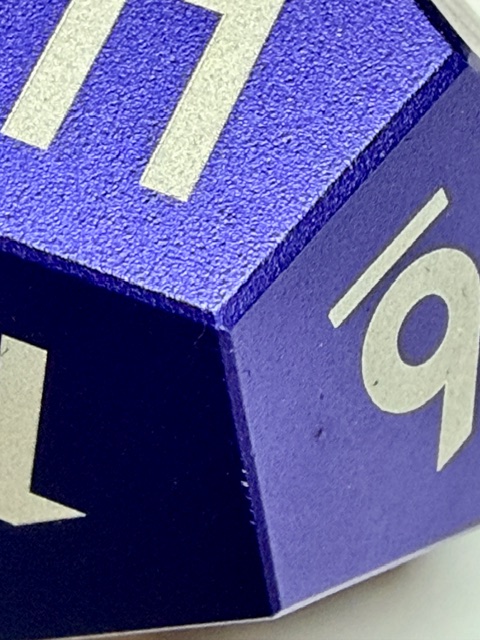
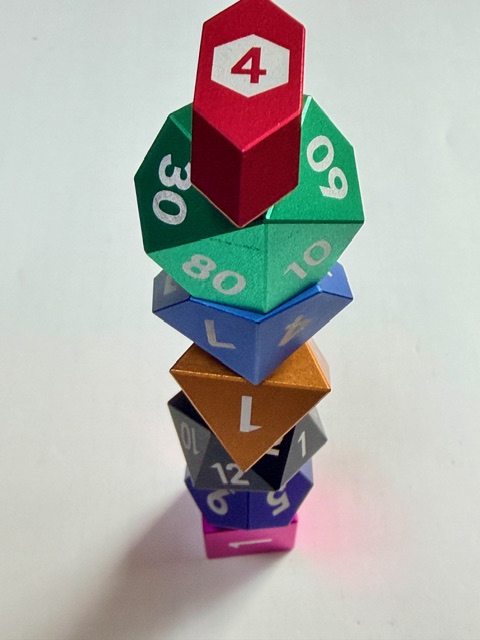
Description: This is a set of seven oversized near-sharp edge Aluminum dice that are anodized in vibrant colors with laser etched numbers. The dice are all standard shapes except for the d4 which is a unique “Hex d4” shape. The font is a modified custom font “based on the Futura typeface” according to Flying Horseduck. The high faces on each die have a laser etched hexagon with the number of that face un-etched (negative space) inside. The 6 and 9 faces use underbars to indicate their orientation. The dice came in nice faux-leather boxes with magnet lids and firm foam inserts with cutouts for the dice to fit very snugly.
Size:
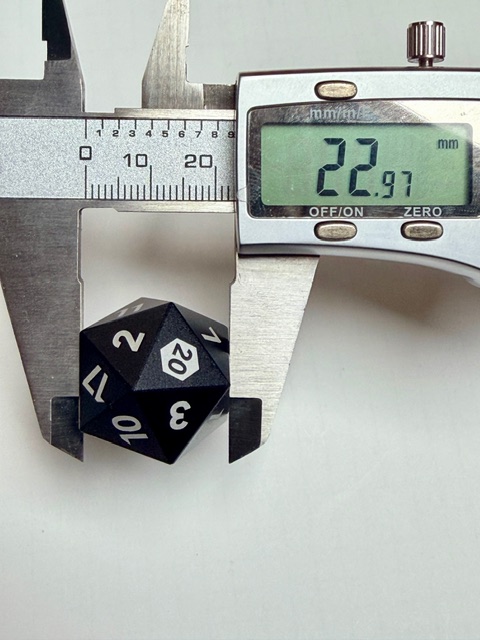
d20: (Face->Face) 22.97 mm (Point->Point) 28.40 mm
Where did they come from: Flying Horseduck on Kickstarter
How much did they cost: $129
Material / color: Anodized Aluminum in red, magenta, royal blue, indigo, Kelly green, orangeish-bronze, and black with silver etched numbers.
Quality: Amazing!
Readability: Excellent!
Value: Good.
Overall Rating: 10/10 (Ten feels low for these dice)
Attempts needed to roll a natural 20: 9 rollsFifty One Hundred d20 rolls: 15, 4, 5, 6, 5, 14, 10, 4, 8, 5, 14, 6, 6, 14, 16, 3, 3, 18, 2, 13, 10, 20, 16, 8, 7, 19, 15, 11, 11, 20, 15, 17, 17, 9, 13, 2, 4, 15, 14, 11, 15, 19, 17, 18, 11, 19, 4, 6, 7, 9, 14, 1, 7, 1, 20, 3, 10, 1, 16, 13, 15, 3, 9, 4, 10, 7, 1, 12, 10, 3, 9, 14, 16, 17, 6, 14, 18, 5, 18, 14, 18, 15, 20, 11, 2, 17, 14, 14, 19, 19, 18, 19, 20, 18, 16, 2, 7, 16, 20, 1
Mean: 11.27
Median: 12.5
Mode: 14
Chi-square: 13.60 **
Result: Balanced

4d6 drop 1 stat block: 9, 16, 10, 11, 12, 11 (69 total) A Cool-headed Half-Elf (Wood Elf) Rogue from an aristocratic family who knows seven dangerous secrets
For reference: the Standard Array method totals to: 72 and the Point Buy method totals to: 69.
A 20th level Rogue with maxed DEX and expertise who casts Pass Without A Trace (Wood elf magic) making stealth checks with an increasing DC to pass.
1st attempt (DC10): 18 + 12 + 5 + 10 = 45 SUCCESS!
2nd attempt (DC15): 6 + 12 + 5 + 10 = 33 SUCCESS!
3rd attempt (DC20): 2 + 12 + 5 + 10 = 29 SUCCESS!
4th attempt (DC25): 7 + 12 + 5 + 10 = 33 SUCCESS!
5th attempt (DC30): 15 + 12 + 5 + 10 = 42 SUCCESS!
6th attempt (DC35): 5 + 12 + 5 + 10 = 31 FAIL!
The range of possible values here goes from 28 – 47 while using Pass Without A Trace on top of the Rogues +17 expertise in stealth.
Random Tables rolls:
Resurrection Side Effects: – 95 Your body has died before, and learned from it. When taking damage from a damage source that matches the one that killed you (Bludgeoning, Piercing, Elemental Damage, etc.) you have 1 damage resistance. (I would totally use this as a house rule in my campaigns!)
Secret Societies: – 45 The Order of the Mask, a group of revolutionaries and enlightened thinkers who believe that a republic is the only way forward for society. They idolise a Masked Jester, whose name is lost in history, who assassinated the last of the great kings of the kingdom and caused a century of strife. The Jester would likely be bemused if he was brought back, he killed the king because it was fun.
(I’m getting these random tables at: https://d100tables.com by the way
Final Thoughts: These dice are from a Kickstarter campaign that I backed in March 2025. I’ve been (mostly) patiently waiting for them to arrive. This is the 3rd campaign from the same dice maker (Flying Horseduck) that I’ve backed on Kickstarter and all of them have exceeded my expectations. The quality of their dice is top of the charts. They’re expensive but they’re so well made and beautiful that the price is justified to me.
I’ve been looking for a good set of Aluminum dice for 3-4 years now. All of the other Aluminum dice I’ve found online have been blotchy colored dice, or had what looks like a paint spatter pattern on them. I just wanted plain one-color Aluminum dice that were a little bigger than standard size. These dice are exactly that. The person behind Flying Horseduck has built a reputation for producing very high quality dice so this Kickstarter campaign was funded in 8 minutes. I didn’t get my backing in that fast but I was in the first hour. I wanted to be in the first wave for the slight discount on the dice and mainly the earliest shipping dates. It took all of 3 days for the campaign to unlock all of the reward tiers (which is just marketing tomfoolery honestly). The one reward tier that I was interested in was the full set of Aluminum dice in the rainbow colors with each die in the set being a different color. As you may have noticed recently I’ve been buying dice sets with that theme (see posts: 097, 098, 100, 103).
So the dice: They’re big and they’re heavy for Aluminum dice which is due to Flying Horseduck making these dice from 7075 Aluminum alloy. 7075 alloy is more dense, heavier, and significantly higher strength than 6061 Aluminum alloy which most Aluminum dice are made with.
Materials Nerd sidebar: 7075 Aluminum alloy has a Brinell hardness of 135 - 150, far superior to that of 6061 (hardness of 95) or 6063 (hardness of 73). 7075 Aluminum alloy is second to only 7068 Aluminum alloy (hardness of 185 - 190) in strength but 7068 is predictably more challenging to work with.
The edges of these dice have slight chamfers on them so that they’re not razor sharp. All of the edges and vertices are perfectly aligned. The colors that they chose for these dice look gorgeous. They’re vibrant and steady, not splotchy or dull. The laser etched numbers on the faces are in a very proper and easy to read font.
There are a few things about these dice that are different from most other dice.
The first of those things is that the d4 is in a “Hex d4” shape instead of the traditional tetrahedron (3 sided pyramid). The reasons that they give for this are:1) They were never satisfied with way that the traditional tetrahedron d4 rolled
2) The traditional pyramid shape is difficult to pick up
3) The traditional pyramid shape becomes a "caltrop that deals piercing damage" when dropped on the floor.
4) This Hex d4 shape outperforms both the traditional tetrahedron d4 and the shard-style d4 shape in their fairness testing.
I’m fine with all of those reasons but I still like the traditional shape for a d4. I have a set of resin dice also from Flying Horseduck (post 051) that have this Hex d4 shape and I don’t really love it or hate it. This Hex d4 does have neat bevels and rhombic sides near the vertices which I like. If you hold it with just enough pressure on those vertices you can rotate it around it’s vertical axis which is fun. Overall though, this is probably my 3rd favorite d4 shape. I still like the traditional tetrahedron and the shard d4 shapes better than this one. I find this shape too boxy and rectangular. It’s like I’m rolling a tiny box of Hobnob digestive biscuits or something similar. I think that the bottom line of why I’m not a big fan of this shape is that I don’t like that it can only roll on one axis. Of course this Aluminum d4 is still an absolutely gorgeous die.
The next thing that’s different about these dice that you’d think I would hate is that the 20 face on the d20 has the ’20’ shown in negative space inside a solid hexagon. As I’ve prattled on about in several other reviews, I absolutely do not like logos on the 20 face. I am however fine with this hexagon design though because the number 20 is still on the face and I can still get that quick “WOO! Nat 20!” dopamine hit when I roll a 20. The solid hex with the negative space number is on the high face of all of the dice in this set and I’m all fine with it. When you see them all together with the high faces showing, they look very cohesive.
The last thing that’s different about these dice isn’t immediately noticeable. The number placement on Flying Horseduck’s dice is not the standard “opposite sides of the die sum to the number of sides of that die plus 1” rule that 99.9% of all other dice follow. Flying Horseduck use an alternate number layout to make them more mathematically balanced to avoid concentrations of high or low numbers on the surface of the dice. In their words:"The standard numbering layout of dice is not even close to being balanced. The goal of balancing a numbering layout is to avoid concentrations of high or low numbers. A die with a balanced layout will be more fair since a bias of the die will have a lesser impact on the mean roll compared to non-balanced dice."
There is a lot more detail about how the numbering layout was determined and statistics comparing it to the standard layout on their website: https://honestdice.com/pages/mathematically-balanced
So their goal was to first: make balanced dice, and second, to use a number layout that will mitigate the bias of a die if it ends up being unbalanced anyway. To try to prove this, they took an aluminum d120 (yes, one hundred and twenty sides) with their “balanced number layout” and drilled several holes in faces on only one side of the die to create a huge weight bias. Then they performed a 2000-roll test and showed that the roll distribution was still very balanced and within the tolerance that you would expect from a fair/balanced die.
I’ve been a (computer/math) nerd since I was a teenager so this kind of detail and testing absolutely fascinates me. In fact, after reading all of that stuff that I just wrote about above, I decided to follow a guideline that Flying Horseduck highlights for my reviews that says: “for a dice roll test, you should have at least N*5 rolls in your test where N = number of sides on the die you’re testing.” I’m going to update my review template to use a 100 roll dataset. / histogram going forward. This is the minimum number of rolls that should begin to indicate the fairness / balance of a die. The only downside is the extra time that it’ll take me to do the extra rolls. The things I do for the 5 people who read these reviews (and probably skip all of this word salad and just look at the pretty pictures)….
With all of that said, I think of these dice as “evolved” for a few reasons: They’re larger, they’re made from aircraft/space grade Aluminum, they’re much more durable than other dice, they’re anodized instead of painted, and they have mathematically balanced number layouts. These are not art but I find their symmetry and tight tolerances beautiful anyway and I’m very happy with what Flying Horseduck has delivered.
Over time, dice have evolved through several different materials: plastic, resin, Zinc, stone, glass, wood, bone, Aluminum, Steel, and other less common elemental metals. I think that it will be tough for me to find dice that are better than these for my collection. I don’t have the kind of “FU” money that it would take to buy a nice set of Tungsten dice or something more exotic.
These dice were a big one-time run for a Kickstarter campaign, I hope that Flying Horseduck made extra sets of these dice to sell in their store (honestdice.com). They’ve done that with their previous kickstarter campaigns, so maybe other people (like you, reader!) can buy some.
In addition to this Aluminum set, I also got another set of even fancier dice from this Kickstarter campaign along with an aluminum d60. I’ll be reviewing both of those in future posts. Stay tuned.
** I’ve added a new value to the reviews called “Chi-square” which is a calculation of the difference between of the number of times each value was rolled in the d20 roll test compared to the number of times each value would be rolled in a perfectly equal roll test. (perfectly equal means every value comes up the same number of times, or [total number of rolls / number of sides on the die]) Chi-square gives a sense of how far away from the statistical average the results of the d20 roll test were. It’s not a perfect measure of a die’s balance and fairness but it’s a good step in that direction. More information about die fairness / balance roll testing can be found here: https://rpg.stackexchange.com/questions/70802/how-can-i-test-whether-a-die-is-fair
Leave a Reply